Las lecciones: What I learned from teaching & traveling in Colombia
Around this time last year, I accepted a temporary teaching position at a bilingual international school in Colombia. Now I’m back in Toronto, surrounded by familiar faces and the comforts of “home.”
In some ways, it feels like I’m in the same place I was before I left. But travel is an incredible teacher, and my experiences in Colombia have taught me some valuable lessons that I hope will help me live a healthier, happier, more meaningful life in Toronto. Here are some of the lessons that I learned from teaching and traveling in Colombia.
Lesson 1: We are not our past.

The class sat around in a circle while ‘José’ told his story.
Everyone was crying including me. José told us that he had been bullied since Grade 2, especially by three other boys in the class. He couldn’t take it anymore. Due to the stress he’d experienced at school, he was acting out at home, being rude to his parents and mean to his sister. He was thinking of switching schools so he could have a fresh start. But he didn’t want to. He liked the school and the teachers and his friends and the extra-curricular clubs he participated in there.
After he spoke, each student told José something they appreciated or admired about him. The bullies apologized. José forgave them. Everyone cried some more. A group hug ensued.
A group of ten year olds had committed to starting over. They rose above their past and the identities of “bully” and “victim” they’d been living in for years.
A similar process has occurred in the political landscape of Colombia, but at a much larger scale.
After nearly four years of peace negotiations, the Colombian government is on the brink of finalizing a deal with the FARC guerrillas it has been fighting since 1964. According to the United Nations, the conflict has left more than 220,000 dead and driven nearly seven million Colombians from their homes.
The peace accord is an opportunity to formally end decades of violence. As the New York Times writes, “Victims of the conflict, many of whom have supported the process fervently, deserve recognition for their willingness to forgive. By facing down an enemy across the negotiating table, they set a laudable example at a time when so many of the world’s armed conflicts appear intractable.”
Thus, an important lesson I took away from living in Colombia is that clinging to past identities does nothing but cause more pain, more suffering, more violence. It is never too late to forgive, accept, more forward, re-build.
Lesson 2: Growth occurs through struggle.
I tell ‘Natalia’ to go to the office. She’d just thrown an eraser at ‘Elizabeth’ and I’m on the verge of breakdown. Five other students are already staying in for detention at recess.
I just want them to stop talking and listen.
I want them to learn math. I want them to WANT to learn math. I want to be doing a better job right now. But I’d never taught math before. I’m trying my best. Sometimes my lessons suck but I’m learning.
‘Martin’ walks up to me while I’m in the middle of teaching a strategy for multiplying fractions. He shows me his Hatchet quiz and asks me why I’d taken a mark off for #5. You’re unfair. It’s Friday and we are supposed to be playing. We are just kids.
I know you’re kids but the class’ behaviour was terrible today and you didn’t earn your free time. We didn’t cover what we were supposed to cover in math.
Fernando’s on the couch! ‘Monika’ yells from the back of the class. He’s not sitting in his seat. You’re unfair. It’s Friday and we are supposed to be playing. I don’t get fractions!!!
I take a deep breath.
I’m about to lose my shit. I knock on the teacher’s door beside me and ask him to watch my class. I walk around campus for two minutes, look at mountains, remind myself that life is beautiful and everything is going to be okay, then I go back to teaching math.
*
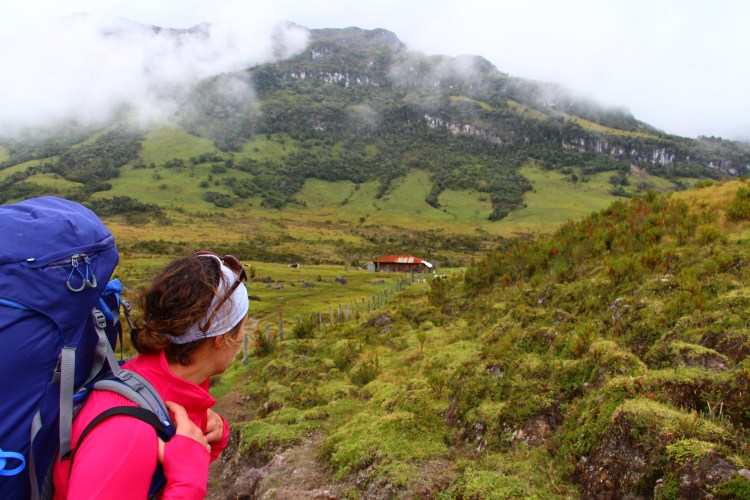
I avoid looking to my right at what looks like a 50 foot sheer drop into the dense jungle below. My heavy pack, filled with my tent, camping gear, and remnants of a week’s worth of food, throws me off balance as I carefully place my hands and feet on tree roots to pull myself up a steep, muddy cliff face. My body’s shaking, cold from the rain and terrified by my irrational fear of heights. All I can think is: Get me the fuck out of here.
We’ve been hiking for over 6 hours after a week of camping in Los Nevados National Park, and I just want to get home. But then getting home will involve another 4 hour drive in a jeep in my wet, smelly, camping clothes, and my family’s all back in Canada, enjoying the rest of their Christmas holidays, sitting warm and dry by the fire like normal people while I’m bushwhacking through the high-altitude cloud-forest in the Colombian Andes, so where’s home anyways?
*
It smells like gas. I say. The man looks at me blankly as I wave my hand in front of my nose and point to my gas tank by the washing machine.
He gestures towards the gas tank and asks me an onslaught of questions in Spanish. I don’t understand anything.
This continues for a few minutes. I’m feeling incompetent and incredibly helpless. What am I doing here?
I type: “There’s a gas smell” into Google Translate and show him on my phone. He reads it and then types something himself.
Carbon Monoxide. I read. Is he telling me that there is a carbon monoxide leak in my apartment? Am I going to die in my sleep?
I call my friend, Jill, and ask her if she can speak to the contractor in Spanish over the phone. I hand the contractor the phone and he explains the situation to Jill. A valve was open. Some gas did leak. I’m not going to die. Keep the windows open. The smell should go away in a couple of hours.
Gracias. Gracias. Gracias. I say because it’s all I CAN say.
*
Colombia’s been ranked as the “Happiest Country in the World” twice in the five years, according to the WIN/Gallup International Association’s annual end of year survey.
So I found myself reflecting a lot about whether or not happiness is something I should be aspiring towards. (I wrote this blog post about this dilemma when I first arrived.)
During the year, locals often asked me if I was happy. Si, si. Estoy muy contenta. I’d say, after I learned enough Spanish to be able to do so. In some ways I was.
But there were definitely many low moments.
Life was really hard for me at times. I cried ALOT (especially at the beginning). During these moments, I’d beat myself up for not being “happy,” as I thought I should be. Look at all these incredible pics my other friends here are posting on Facebook about their amazing adventures. What’s WRONG with me??
Because I stuck it out during hard times, I learned some great teaching strategies that I can apply to future jobs. I can now speak broken Spanish, and decided to register for a course in Toronto so that I can continue to improve. The physical challenges that I undertook in the mountains taught me greater patience, discipline, and the importance of living in the moment.
While I don’t think I should seek out opportunities for sustained unhappiness, living in Colombia taught me the value of struggle. Many aspects of living and working in a foreign country were challenging. I often thought of quitting and coming back to Canada where people spoke my language and life was a little easier. Yet these struggles provided opportunities for incredible growth, which helped me become a stronger, more balanced, and tri-lingual (ish) person.
Lesson 3: Live in COLOUR.

In Kanata, a suburb in Ottawa, Canada, just minutes away from where I grew up, there’s a city by-law which regulates the colours of homes and garage doors. Basically, if you paint your exterior doors purple, you will get fined. In contrast, the Colombian towns of Guatapé, Salamina, and Salento, look like a giant package of Skittles exploded and painted the whole town in rainbow. Colour is EVERYWHERE.
I’m not blaming Kanata’s bland garages on my shyness or how I’ve often placed limits on my own potential. But Colombia’s colourfully warm and vibrant culture inspired me to live bigger, brighter, and more passionately. It reminded me to embrace opportunities for love and adventure, even when they seemed like silly fantasies.
So when my friend and teaching partner, Matt, introduced me to the “20% Percent Project” which he had done with his class for the last couple of years, I quickly jumped on board. It’s a project which is inspired by Google’s mandate that its employees spend 20% of their time at Google to work on a passion project, something not covered by their job description. This allows innovative ideas and projects to flourish and/or fail without the bureaucracy of committees and budgets. As a result of Google’s 20% Project, its employees created Gmail, AdSense, Google News, and the Google Teacher Academy.
Following Matt’s lead, I required that my students devote 20%(ish) of class-time learning about something that they are passionate about, something that adds colour to their lives. For their projects, they needed to choose a topic that they were excited to learn about, where they could apply research to creation and innovation.
They wrote weekly reflections on a blog that they shared with their classmates and presented their projects to their parents and school community in a TED-style 5 minute presentation at the end of the school year. The results of this project were unbelievable. My class of grade five students invented board games, wrote cookbooks, created craft books, created stop animation movies with characters and sets made out of LEGO, and built a model “Future House” using sustainable materials. It was amazing.
This project also inspired me to devote 20% of my own time to exploring my passions. As a result, I started the Inspiring Women Series podcast. I prioritized writing, travel, and living according to a healthy, active lifestyle. I spent five weeks traveling in Colombia with my parents, my brother, Brian, and my friend, Ashley. Then I spent most of August getting my novel ready for publication.
By learning to see the world (and myself!) through a more colourful lens, I was able to see greater possibilities for my life, and inspire my students to do the same.
Lesson 4: It’s okay to take care of yourself.
A few days ago Hillary Clinton took time off from the campaign trail to recover from pneumonia. She received much criticism for this decision, from people who condemned her for not being able to “power through” her sickness, to others who blamed her for not being more forthcoming initially about her medical condition. This criticism came to no surprise to me, as North Americans perceive taking time off as weakness.
My first couple of years of teaching, I never called in sick out of fear of being judged. When I was in university, I played rugby games with serious injuries because the culture of the sport promotes an invincibility complex. Needless to say, when I was required to take more than two weeks off of teaching after being attacked by a wild dog in Colombia, I felt very stressed out. A committed employee persists despite the pain, right?
Instead of making me feel pressured to come back to work, people from my school community came to visit me at home and in the hospital and even had food delivered to my house daily. They helped me to realize that my health was more important that my job, and that I don’t need permission to put myself first.
In Colombia, the attitudes towards self-care and rest are strikingly different than in North America. Colombia has the second highest number of national holidays in the world (after Argentina), with 18 public holidays and an average of 15 paid vacation days. Comparatively, Canada ranks third last in paid vacations. It’s hard to feel anything but lazy when you take time off in a culture where productivity is valued over health.
Living in Colombia helped me realize that taking care of myself is not a sign of weakness. In fact, it takes a lot of strength to say: I need help. I need time off. I need a break.
Lesson 5: Paths aren’t always linear.
There’s an underlying pressure in North America to follow a linear path. Go to school. Get X degree. Get Y job. Find husband. Buy house. etc. We are uncomfortable with living in the moment, allowing life to unfold organically. It feels stressful/ silly/ irresponsible to even consider opportunities that aren’t a tangible stepping stone to something else (especially if they don’t come with a pension or benefits!).
So when an opportunity for me to teach in Colombia presented itself to me, my immediate reaction was “well, maybe this would have been great a few years ago, but it’s time for me to ‘settle down.'”At the time, I was intending to stay in Toronto, and start building my life there. I wasn’t seeking out positions that would take me away from the city.
Since I’d never been to South America, I decided to apply for the job despite the rational side of my brain telling me not to.
A few days later, I had a great interview with the director of the school. While I felt positively about the position, I was booked to fly to Johannesburg for a trip to South Africa later that day, and figured that seeing wild beasts on a safari in Kruger National Park would satisfy my thirst for adventure. I told the director thank you for the interview, but it is probably best if you interview other people as I’ll be offline for the next two weeks.
When I returned from South Africa, the director of the school requested a second interview. I panicked and ignored his e-mail for a day. It would have been much easier for me if he’d hired someone else. I could tell myself that going to Colombia to teach was a nice idea. But an unrealistic one.
I went for coffee that day with my cousin, Jenn, who was pregnant with twins at the time. I told her about the job prospect, and about my plan to tell the director that there was no point of going through the interview. I didn’t want the job anyways. She suggested that I go through the interview, and then decide. Keep my options open. Darn hormones!
After the second interview, the director offered me the job. I had the weekend to decide. I made pros and cons lists. Talked to my friends and family. Convinced myself that I would be better off not going. When I sat down to write the director the e-mail, thanking him for the offer, and telling him of my decision not to come, the e-mail somehow transformed into a “thank you for the offer and I’ll accept the position.”
A few days later, I was offered a teaching position with the school board in Toronto. Of course. After four years of applying for jobs in Toronto and hearing nothing, I get offered a job NOW. The logical, rational, choice would have been to tell the school in Colombia about this unanticipated change in plans, and continue down the path I had intended for myself.
Teaching in Colombia was something I’d stumbled upon, not something I’d planned. Instead of finding the job, the job kind of “found me.” This experience taught me that sometimes it’s best to accept the gifts that life gives us, even if it takes us in an entirely different direction. I feel so grateful that I did.











 Shannon Mullen